
1- ANR project
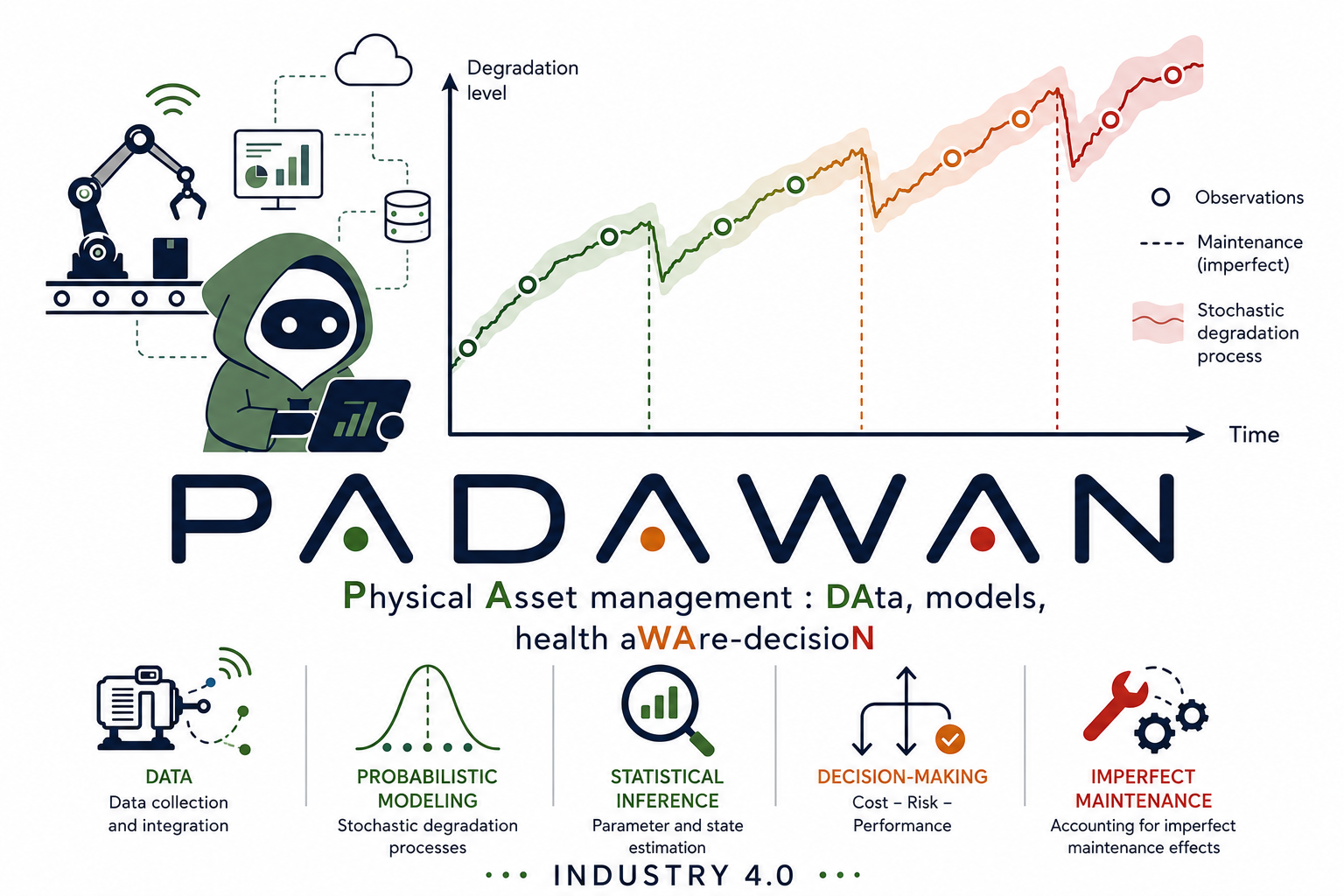
PADAWAN is a project funded by the French National Research Agency ANR related to the research area: “Industry and the Factory of the Future: People, Organization, Technologies” (CE 10). It is a four-year project that began in April 2026 and aims to develop mathematical methods to help manage instrumented industrial assets undergoing maintenance. The PADAWAN project brings together 6 research laboratories at various French university campuses:
2- Context
Managing the health of industrial assets and extending their lifespan, through a reliable supervision of their usage, and consequently their wear-out level, and an optimized efficient maintenance, is one of the key issues for the industry of the future. As systems become more connected and sensors provide more data, there is a great opportunity to develop effective prescriptive maintenance policies. However, the use of time-continuous sensor data should not reduce the importance of traditional sources of information like inspections, maintenance actions, alarms, and failures. The availability of data is undoubtedly a prerequisite for effective asset monitoring, but nothing but the processing and exploitation of all the available information will create value by making possible to avoid failures while limiting false alarms and costly inspections, and by being more proactive in adapting operating conditions and maintenance periods. On the other hand, the size, heterogeneity, quality and cost of the data make the tasks of modelling, calibration and decision-making more complex and difficult, and therefore require advanced and adapted mathematical tools.
3- Research framework
For critical industrial assets, modern feedback databases may simultaneously contain measurement values for different types of indicators, which are more or less related to the actual state of degradation of the systems under study. Among the standard types of data that can provide information on the evolution of degradation are the following.
-
Some indicators are degradation measures made during detailed inspections on various strategic points of the equipment. These types of indicators are generally highly representative of the actual state of internal degradation, but are costly to obtain because of mobilization of human and material resources, often with shutting down of the equipment. Critical systems may also be subject to regulatory constraints on the levels of some degradation indicators.
-
The state of degradation can also be evaluated using automated measurements of the operating performance of the system. The advantage of these types of indicators is that they are generally much cheaper to obtain. But on the other hand, they are often less representative of the actual state of degradation than those obtained by inspections, especially for closed-loop systems. In fact, they often result from a combined effect of the actual level of degradation and of conditions of use and operation of the equipment.
-
Sensor data can also be available and can be linked to the level of degradation. However, these types of data correspond more often to measurements of environmental and usage conditions. The advantage is that once the sensor has been installed, the cost of acquisition is negligible and can be carried out almost continuously. However, in practice, the various sensors may have different acquisition frequencies, they may also have problems of unavailability or missing data, or even not be installed uniformly throughout the fleet of equipment under study.
-
Expert knowledge and other a priori information on systems characteristics and structures, wear states and maintenance effects can also be available.
For monitored critical assets in the context of the industry of the future, multivariate observations of these different types of indicators should be available on each equipment. Their values are dependent on each other since they are linked to the same asset under consideration and to common degradation phenomena. However, as explained previously, these indicators are generally highly heterogeneous both from their acquisition frequencies as well as from the level of information they provide on the actual state of degradation. Some of these indicators may also be subject to detectability problems and measurement errors. In order to mitigate degradation and ageing, critical industrial assets are also subjected to various types of maintenance actions (preventive, corrective, overhauls, planned, conditional, …) with varying degrees of importance and effectiveness. Those maintenance actions have naturally an effect on the immediate level of degradation, but they can also modify the degradation dynamic evolution after the maintenance. Finally, equipment can sometimes fail, which may correspond to critical events or simply degraded operating states requiring intervention on the system or compromising its ability to perform its functions efficiently. Most critical industrial assets are falling within this general framework, e.g. in the context of nuclear and wind power applications, water supply system, aeronautics. Analysing and adding value to such complex historical databases on degradation measurements and maintenance actions require complex mathematical models to be able to take into account all the wealth of information available. This is the aim of this research project, which proposes cutting-edge mathematical methodologies upstream of the tools traditionally used in the context of the industry of the future.
4. Objectives
The first objective of this project is to develop general stochastic mathematical models of multivariate degradation indicators that take into account their interdependence, as well as the effect of the successive maintenance actions, unexpected events and replacements. The second objective is to develop methods for selecting and calibrating these models as well as for forecasting the evolution of the degradation according to different future maintenance scenarios, operating conditions, or usage levels. These methods are based on historical data from monitoring degradation measurements and maintenance actions. They should be able to manage general schemes of observations. Finally, the third objective is to be able to use the calibrated model to propose decision-making strategies for the optimization of predictive/prescriptive maintenance actions (within a comprehensive asset management strategy). This will, of course, involve optimizing the dates and types of the various maintenance actions. However, the goal is also to develop dynamic policies in which the dates and types of degradation measurements can also be optimized online according to predicted changes in the level of degradation. The multivariate degradation model will enable the optimization of fleet for industrial assets by integrating global operational constraints and considering how to optimize the usage conditions and solicitations according to the observed and predicted degradation trends. The strength of the project lies in its ability to build an integrated approach that enables a modelling/data analysis/decision-making loop. Finally, we aim to federate the scientific community, both academic and industrial, working on mathematical methods for degradation modelling, maintenance decision-making and asset management